This guide walks you through a complete end-to-end example: fetching a live options chain for a publicly traded stock, building the required market inputs, fitting a ProbCurve, and querying the resulting risk-neutral probability distribution. By the end you will have a working script you can adapt to any ticker.
1

Install

Install the library from PyPI. The standard install includes the built-in yfinance data connection used in this guide.
pip install oipd
2

Fetch data

Import the modules you need, then use sources.list_expiry_dates to see every available expiry for your ticker. Pass one of those dates to sources.fetch_chain to download the options chain and a market snapshot at the moment of download.
import matplotlib.pyplot as plt

from oipd import MarketInputs, ProbCurve, sources

ticker = "PLTR"                               # specify the stock ticker
expiries = sources.list_expiry_dates(ticker)  # list all available expiry dates
single_expiry = expiries[1]                   # pick the expiry you're interested in

# fetch_chain returns the options chain and a market snapshot
chain, snapshot = sources.fetch_chain(ticker, expiries=single_expiry)
chain contains the full options chain (calls and puts, strikes, bid/ask, open interest). snapshot captures the underlying price and the timestamp of the download — both of which you need in the next step.
3

MarketInputs

MarketInputs bundles the three pieces of market context that OIPD needs to fit the model: the valuation date, the underlying price, and the risk-free rate. Pull the first two directly from the snapshot you just downloaded.
market = MarketInputs(
    valuation_date=snapshot.asof,               # timestamp of the data download
    underlying_price=snapshot.underlying_price, # spot price at download time
    risk_free_rate=0.04,                        # use a Treasury yield close to your expiry horizon
)
For risk_free_rate, use the US Treasury or Fed Funds yield whose maturity most closely matches the time to your chosen expiry date.
4

Fit

Pass chain and market to ProbCurve.from_chain. This single call fits the SVI implied volatility smile and derives the risk-neutral probability distribution in one step.
prob = ProbCurve.from_chain(chain, market)
The returned prob object is fully fitted and immediately queryable. No separate .fit() call is needed when using the from_chain factory.
5

Query

Use the query methods on the fitted ProbCurve to extract the statistics you care about.
prob_below = prob.prob_below(100)   # P(price < 100)
prob_above = prob.prob_above(120)   # P(price >= 120)
q50        = prob.quantile(0.50)    # median implied price
skew       = prob.skew()            # distributional skew
MethodWhat it returns
prob_below(k)Cumulative probability that the price is below strike k
prob_above(k)Probability that the price is at or above strike k
quantile(q)The price level at the q-th quantile of the distribution
skew()Skewness of the fitted risk-neutral distribution
6

Plot

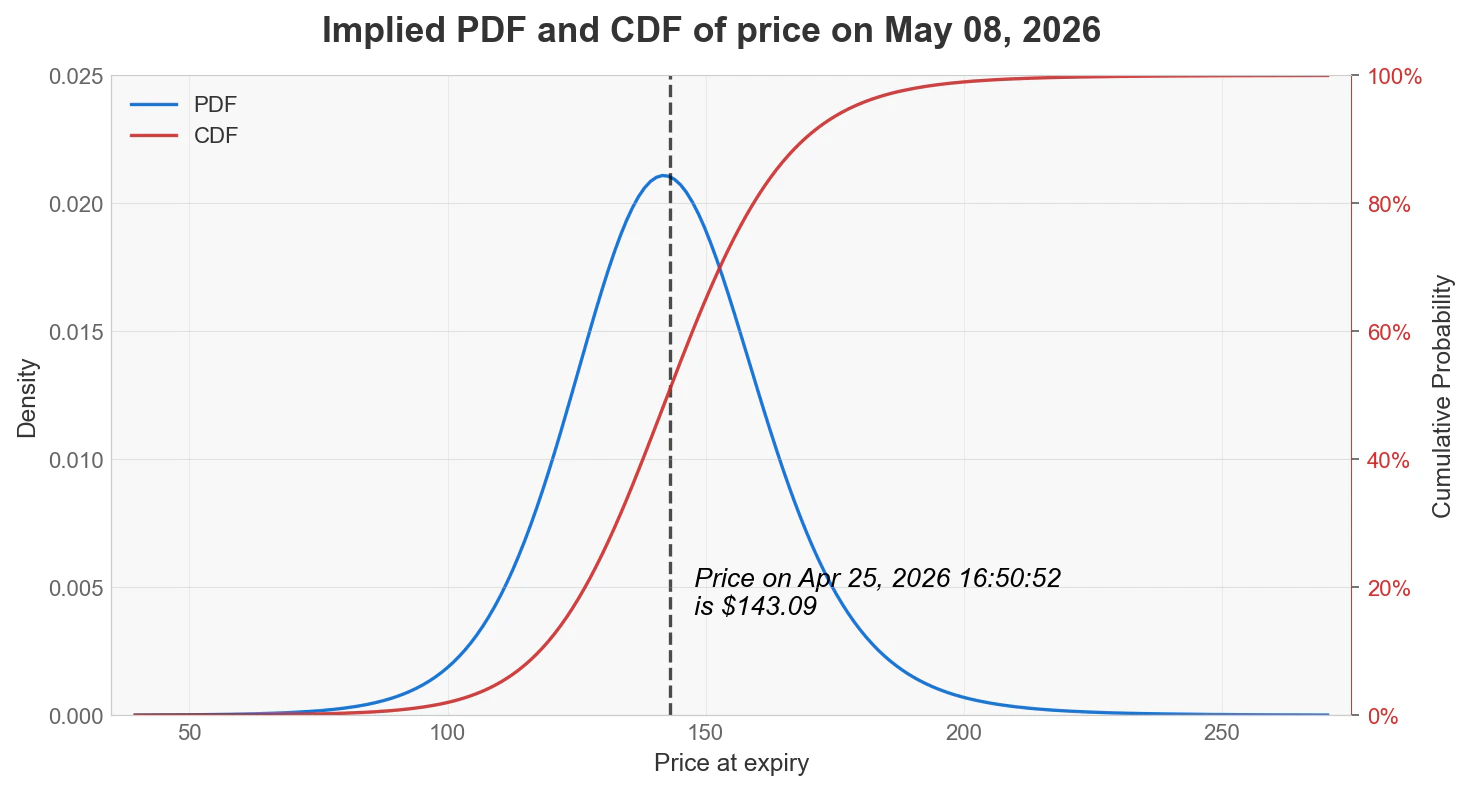
Call prob.plot() to render the probability distribution as a chart. It returns a Matplotlib Figure, so you can save it or customise it with standard Matplotlib calls.
fig = prob.plot()   # kind="both" by default; also accepts "pdf" or "cdf"
plt.show()
To save the chart instead:
fig = prob.plot()
fig.savefig("probcurve.png", dpi=160, bbox_inches="tight")
Example output:Example probability curve plot generated with ProbCurve.plot
This example uses live option data, so your chart will differ as prices, expiries, and spreads update.

Complete script

Here is the full example in one block, ready to copy and run:
import matplotlib.pyplot as plt

from oipd import MarketInputs, ProbCurve, sources

# 1. fetch data using the built-in yfinance connection
ticker = "PLTR"
expiries = sources.list_expiry_dates(ticker)
single_expiry = expiries[1]

chain, snapshot = sources.fetch_chain(ticker, expiries=single_expiry)

# 2. fill in market parameters
market = MarketInputs(
    valuation_date=snapshot.asof,
    underlying_price=snapshot.underlying_price,
    risk_free_rate=0.04,
)

# 3. compute the probability distribution
prob = ProbCurve.from_chain(chain, market)

# 4. query and visualise
fig = prob.plot()
plt.show()

prob_below = prob.prob_below(100)   # P(price < 100)
prob_above = prob.prob_above(120)   # P(price >= 120)
q50        = prob.quantile(0.50)    # median implied price
skew       = prob.skew()            # distributional skew

Next steps

Probability surface

Fetch a multi-expiry chain with sources.fetch_chain(..., horizon="12m"), then pass it to ProbSurface.from_chain.

Volatility smile

Work directly with VolCurve and VolSurface to evaluate implied vols, price options, and compute Greeks.

Data sources

Load data from a CSV or Pandas DataFrame instead of yfinance for corporate or internal data environments.

Warnings

Understand how OIPD surfaces data quality and model risk issues through structured diagnostics on every fitted object.